December 10, 2025
The Future of Subscription Content: Predictions for the Creator Economy
Explore the trends shaping the creator economy and learn how subscription-based platforms are driving the future of monetized content.

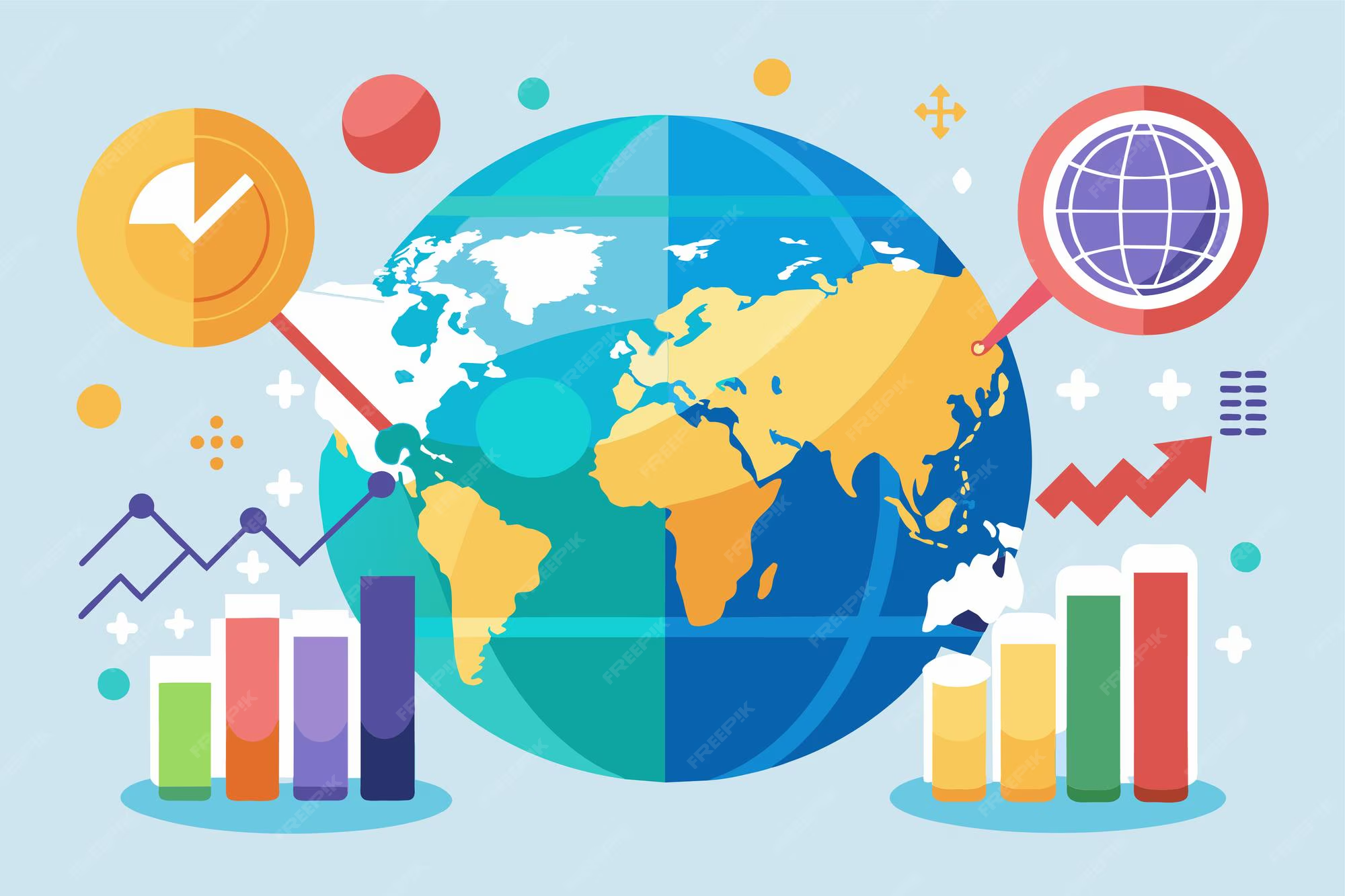
The creator economy is no longer emerging — it is restructuring digital monetization at scale.
In 2024 alone, OnlyFans processed over $7.2 billion in fan payments, signaling sustained global demand for direct-to-creator subscription models. But the broader shift extends far beyond a single platform. Subscription-based monetization is becoming a structural pillar of the internet economy.
The question is no longer whether subscription content works.
The question is how it will evolve.
Below are evidence-based predictions grounded in platform economics, behavioral psychology, and digital business trends.
For over a decade, creators relied heavily on advertising revenue, sponsorships, and algorithm-based monetization systems (YouTube AdSense, brand deals, affiliate links). These models created volatility because creators did not control pricing or distribution.
Subscription platforms invert that dynamic.
Instead of relying on brand intermediaries, creators monetize audience loyalty directly. This aligns with broader digital shifts toward the “passion economy,” a term popularized by Li Jin to describe monetization models where individuals build businesses around niche audiences.
https://a16z.com/100-true-fans/
As trust in traditional advertising declines and audiences increasingly value authenticity, direct support models will likely continue expanding.
Prediction:
Platforms that enable direct creator-to-fan payments will outperform ad-dependent ecosystems in long-term revenue stability.
One of the biggest misconceptions about subscription content is that scale is everything.
In reality, niche depth often outperforms broad reach.
Kevin Kelly’s “1,000 True Fans” concept argues that creators don’t need millions of followers — they need a relatively small group of highly committed supporters.
https://kk.org/thetechnium/1000-true-fans/
Subscription models amplify this principle. A creator with 500 highly engaged subscribers can generate more predictable income than someone with 500,000 passive followers.
As competition increases, we will likely see:
Broad visibility may generate awareness.
Niche authority generates recurring revenue.
As subscription markets mature, acquisition costs rise.
This is a universal economic pattern: early growth is driven by expansion; later growth is driven by optimization. Harvard Business Review has long documented how customer retention dramatically increases profitability compared to pure acquisition strategies.
https://hbr.org/2014/10/the-value-of-keeping-the-right-customers
In subscription ecosystems, retention affects:
Future creator success will rely heavily on:
The next phase of the creator economy is not about who can attract the most traffic.
It is about who can keep attention the longest.
Artificial intelligence is already influencing content production, analytics, and audience management.
According to McKinsey’s research on generative AI adoption, digital content industries are among the fastest adopters of AI-driven workflow optimization.
In the creator economy, AI will likely:
However, there is a paradox.
As automation increases, authentic human connection becomes more valuable — especially in subscription-based ecosystems where emotional proximity drives monetization.
Technology will scale efficiency.
Authenticity will remain the conversion driver.
Creators once relied on a single dominant platform.
Today, sustainable subscription growth depends on multi-platform funnel architecture:
Awareness platform → Nurture platform → Subscription platform
Marketing funnel theory consistently emphasizes stage-based conversion models such as See–Think–Do.
https://www.kaushik.net/avinash/see-think-do-care-win-content-marketing-measurement-framework/
In the future, successful creators will:
Single-platform dependency increases vulnerability to algorithm shifts and policy changes.
Diversified funnel ecosystems increase stability.
One of the major risks in the creator economy is platform dependency.
Creators who rely entirely on algorithmic distribution remain exposed to:
This has driven growing interest in email lists, private communities, and direct communication channels.
The broader digital business trend supports this shift toward “owned audiences” rather than rented attention.
https://www.shopify.com/blog/owned-media
Prediction:
Creators will increasingly prioritize channels where they control communication and monetization pathways.
Platform exposure will drive growth.
Owned infrastructure will drive security.
In its early stages, subscription content was informal and experimental.
As revenues scale into billions, the ecosystem naturally professionalizes.
We are already seeing:
This mirrors the historical evolution of YouTube and influencer marketing: what began casually evolved into structured businesses.
The future of subscription content is not amateur experimentation.
It is operational strategy.
During economic uncertainty, consumers often reduce discretionary spending — but they do not eliminate entertainment and personal connection.
Research on subscription economics shows that digital subscriptions, particularly those tied to identity and community, demonstrate surprising resilience compared to traditional advertising markets.
As advertising budgets fluctuate with macroeconomic cycles, direct-to-creator monetization may prove more stable than brand sponsorship dependency.
This structural shift reinforces the long-term viability of subscription ecosystems.
Subscription content is not a temporary trend. It represents a structural shift in how digital value is exchanged.
The future will likely be defined by:
The creators who treat subscription platforms as structured businesses — not side projects — will shape the next phase of the creator economy.
Visibility builds opportunity.
Ownership builds leverage.
Retention builds wealth.
The subscription era is not ending.
It is entering its most strategic phase.
Dive into additional guides and updates to stay on top of trends, strategies, and growth opportunities in the creator economy.